Strategic Shifts: Pyongyang’s Missile and Drone Expansion
North Korea is advancing its military capabilities through a deepening exchange of technology and personnel with Russia, prompting new defensive measures from Seoul.
By Fatima Zayed ·
For residents of the Korean Peninsula, the security landscape is shifting rapidly. The recent testing of new weapons systems and the introduction of a South Korean hypersonic missile signal that the region’s defensive and offensive postures are being recalibrated. This change stems from a growing capability in the North to deploy a wider array of threats, a development that has prompted immediate reactions from its southern neighbor and raises questions about the future cost of air defense for the region.
A report from The New York Times indicates that North Korea is significantly upgrading its ballistic missile program and has commenced the mass production of attack drones. This progression is attributed largely to a cooperative framework with Russia. Under this arrangement, Moscow is transferring military developments to Pyongyang. In return, the North provides soldiers, workers, and weaponry to support Russian military efforts. This exchange has redefined the military relationship between the two states, moving it beyond previous levels of engagement.
The deepening of this partnership began after Russia launched a full-scale invasion of Ukraine. Since that conflict began, North Korea has utilized Russian assistance to modernize its armed forces and equipment. This period of collaboration has allowed Pyongyang to accelerate its technological development, integrating foreign insights into its own defense infrastructure. The result is a more capable military apparatus that draws directly from experiences observed in modern conflicts.
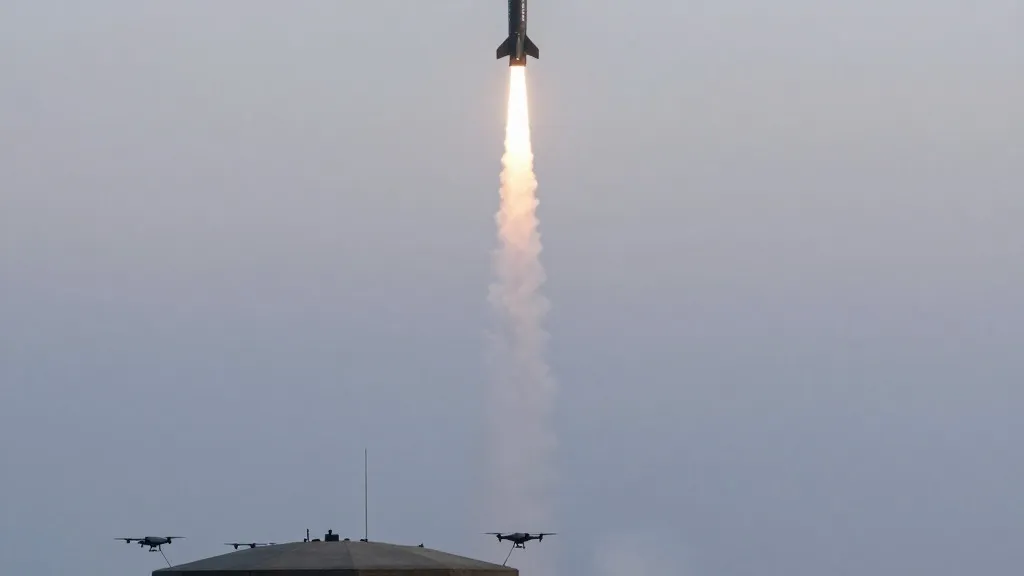
Recent events in early October highlighted the tangible outcomes of this cooperation. Pyongyang tested a tactical ballistic missile that it claims is capable of carrying a nuclear payload. Estimates from South Korea and Japan placed the missile's range at approximately 700 kilometers, or 430 miles. However, North Korea asserted that the weapon traveled 1,000 kilometers, or 621 miles. This discrepancy in range assessments underscores the ongoing efforts by the North to refine and publicize its capabilities.
South Korea’s response to this test marked a notable departure from its usual protocol. Typically, Seoul issues brief statements describing such launches as provocative. This time, however, South Korea conducted its own test of a hypersonic ballistic missile just five days after the North Korean launch. This was the first time Seoul has deployed such a weapon. President Lee Jae Myung personally observed the test, a move that The New York Times characterized as an indication of increasing unease in Seoul regarding the rapid advancement of its northern neighbor's missile technology.
Analysts suggest that a key factor in North Korea’s progress is access to Russian deployment data and feedback. Anton Ponomarenko, an analyst, noted that this information has aided in improving the accuracy and maneuverability of North Korean weapons. He described the evolving threat to South Korea as becoming more substantial due to these enhancements. The transfer of operational data allows Pyongyang to refine its systems based on real-world performance metrics provided by its Russian partners.
Beyond missiles, Russia has assisted North Korea in establishing its own unmanned systems and scaling up production. The New York Times observed that Pyongyang has studied the use of inexpensive drones in Ukraine and the Middle East, noting how such devices can overwhelm expensive air defense networks. In a recent drill last month, a swarm of drones attacked a target island. Simultaneously, cruise and ballistic missiles struck the same target from different directions. This coordinated tactic demonstrates a new level of complexity in North Korean attack planning.
The report suggests that these evolving tactics will eventually compel South Korea and its allies to redesign their air defense systems. Such upgrades are expected to come at an exorbitant cost. The strategic implication is that the economic burden of defense may increase as the North expands its arsenal of low-cost but effective threats. This dynamic creates a long-term pressure on regional budgets and defense planning, requiring continuous adaptation to new offensive strategies.
This development follows other recent accounts of the Russia-North Korea partnership. In September, Bloomberg reported that Russia is employing North Korean citizens to produce military drones, particularly at facilities in Alabuga, Tatarstan. It is believed that up to 25,000 North Koreans are working at Russian military plants. Additionally, a North Korean missile forces unit, potentially equipped with 120 ballistic missiles and six launchers, has begun deploying in western Russia. This unit is prepared for strikes against Ukraine, further cementing the operational link between the two militaries.
Prior to these reports, Ukrainska Pravda noted that Russia requested KN-30 ballistic missiles from North Korea in August. In June of this year, the North announced tests of a modernized 240mm multiple-launch rocket system, a tactical ballistic missile, and a 155mm long-range artillery shell. These successive announcements illustrate a steady pace of military innovation. The ongoing exchange of technology and personnel continues to shape the military balance in the region, with significant implications for neighboring countries and their allies.
Source: Ukrainska Pravda