BGU Students to Design Model Nuclear Reactors in National Competition
Ben-Gurion University has launched a student-led competition to design small modular nuclear reactors, aiming to prepare the next generation of engineers for Israel's potential energy transition.
By Amir Shah ·
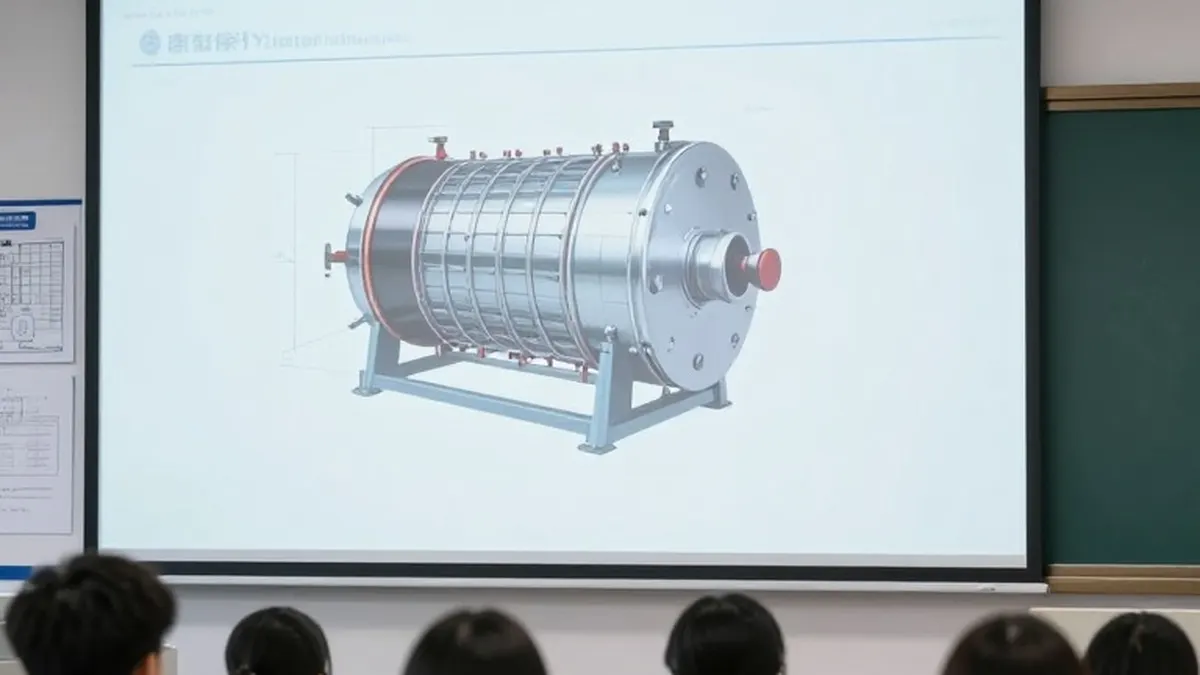
Ben-Gurion University of the Negev has introduced a new academic competition that challenges students to design small nuclear reactors. The university announced the initiative on Thursday, revealing that the winning design will be selected in May 2029, which marks the institution's 60th anniversary. The program, titled BGU’s Nuclear Challenge, seeks to engage a broad cross-section of the student body in complex engineering tasks.
Approximately 40 students from more than 10 different engineering and science departments will participate in the project. These participants will be divided into four distinct teams. Each team is tasked with designing a 60-megawatt small modular reactor, known as an SMR, intended for a reference site in the Negev region. The designs may also incorporate water desalination capabilities. SMRs are defined by their ability to produce up to about 300 megawatts of power, with major components manufactured in factories before being assembled on site.
The initiative is being launched in a context where Israel currently has no operational nuclear power plants. The country functions as an electricity island, unconnected to neighboring power grids, and relies on natural gas for more than 70 percent of its electricity generation. The university noted that the Energy Ministry is formally examining the nuclear option as part of its energy strategy.
The competition is being coordinated by the newly inaugurated Klein Institute for Nuclear Science and Engineering, in partnership with BGU’s Unit of Nuclear Engineering. This unit is the only academic program in Israel authorized to award degrees in nuclear engineering. Prof. Erez Gilad, who serves as both the program chair and the institute’s director, stated that Israel is approaching one of the largest energy decisions in its history. He emphasized that the goal is not to build a reactor immediately, but to build a generation of professionals capable of guiding Israel’s nuclear future wisely.
The university describes the current global landscape as a nuclear renaissance, driven by energy security concerns, emission reduction pressures, and rising electricity demands from artificial intelligence. The International Energy Agency projects that data-center electricity demand will roughly double between 2025 and 2030. Thirty-nine countries have endorsed tripling global nuclear capacity by 2050, and more than 60 reactors are under construction worldwide. Major technology firms, including Microsoft, Google, Amazon, and Meta, have signed nuclear power deals. However, the sector faces a staffing bottleneck, with France alone estimating a need for 100,000 skilled nuclear workers within a decade.
The four student teams have adopted Hebrew names related to light and fire, each focusing on a different nuclear fission technology. The team named Or, meaning light, is designing a compact version of the pressurized water reactor, the world’s most common type. Barak, meaning lightning, is developing a fast reactor cooled by liquid metal. Lahat, meaning glow, is working on a molten salt reactor, while Nitzotz, meaning spark, is designing a helium-cooled graphite reactor. All teams must demonstrate how an entire plant fits together, covering reactor mechanics, cooling systems, safety, costs, and electricity output.
The academic year ahead is dedicated to preparation. Students will join their teams at a public draft day in autumn 2027 and complete a five-day nuclear academy. They will then spend a year operating as small design offices under faculty supervision, with a public presentation scheduled for autumn 2028. In a final proof year, the teams will verify one another’s calculations and defend their designs before independent reviewers.
In May 2029, a panel consisting of faculty, partners, and international experts will select the strongest design that meets pre-published safety and operational requirements. The chosen design will be named BG-SMR-60. The university stresses that this is a civilian academic design program involving no construction or nuclear material. Rector Prof. Yaniv Gelbstein noted that while the reactor designs are important, the graduates will be even more significant. He added that perhaps, one day, a reactor will be built from that design.