Iraqi forces secure key checkpoints in Jurf al-Nasr
Baghdad has begun a major security redeployment in a militia-held area south of the capital, aiming to restore state authority over strategic oil infrastructure and roads.
By Daniela Kelly ·
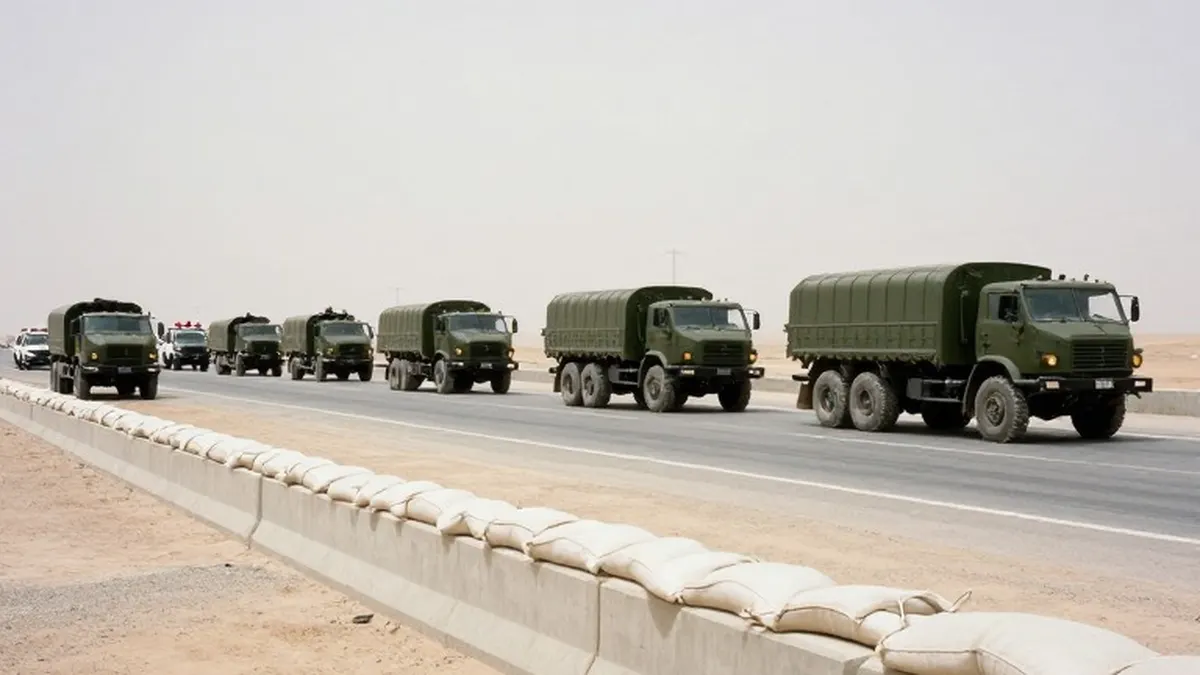
Iraqi government forces have moved to reassert control over Jurf al-Nasr, a strategically significant area south of Baghdad that has been under the influence of the Iranian-backed militia Kataib Hezbollah for roughly a decade. On Saturday, officials announced that the Federal Police had taken command of three major checkpoints in the region. This move marks a critical test for the administration of Prime Minister Ali al-Zaidi as it seeks to bring powerful armed groups under direct state supervision.
The redeployment involves the Iraqi Army, Federal Police, and the Popular Mobilization Forces. Lieutenant General Saad Maan, head of the Security Media Cell, stated that the Federal Police now control the Al-Anwar, Al-Shuhada, and Al-Tahrir checkpoints with the help of PMF liaisons. The operation includes the withdrawal of the 1st Battalion of the PMF's 45th Brigade, which is closely associated with Kataib Hezbollah. Other PMF units, including the 72nd and 79th Brigades, are also part of the new security arrangement.
This transition follows a recent confrontation regarding alleged oil smuggling and interference with pipelines in the area. A compromise reached on November 19 allowed government forces to enter Jurf al-Nasr while militia fighters were reassigned, helping to avoid an immediate armed clash. Maan noted that the handover process is proceeding smoothly and is expected to be completed within a few weeks as military equipment and communication systems are transferred.
A significant component of the operation is the reopening of roads that have been closed for years. The Federal Police have secured the Al-Fadhiliya road from the bridge to the Al-Mayadeen junction, a distance of more than 30 kilometers. Additionally, the Iraqi Army's 38th Brigade is securing the 38-kilometer Ya Hussein defensive line, which borders the Anbar Operations Command. These efforts aim to restore civilian access and commercial traffic to the region, which was previously accessible mainly during religious pilgrimages.
To protect vital energy assets, the Energy Police have established 12 security posts along a 5.2-kilometer section of oil pipelines. Sabah al-Nuaman, the spokesperson for the armed forces commander-in-chief, confirmed that deployments in assigned sectors are complete. A new command headquarters has been set up to coordinate the Iraqi Army, Federal Police, and PMF under a unified structure.
The operation in Jurf al-Nasr is part of a broader effort to address corruption and protect Iraq's oil infrastructure. In a related development, an Iraqi court ordered the arrest of a Najaf provincial council member and his brother, along with eight Energy Police personnel, over suspected oil smuggling. Although separate from the Jurf al-Nasr case, this investigation highlights the challenges Baghdad faces in holding officials accountable for theft.
The government is also prioritizing the return of residents who were displaced from Jurf al-Nasr during the war against ISIS. Maan explained that the current priority is completing the security deployment, followed by the clearance of war remnants and explosives. Infrastructure rehabilitation and the restoration of services are planned for next, with funding for these projects included in the 2027 budget.
Despite the progress, questions remain about the extent of government control. The continued presence of PMF units suggests that the area may be swapping one militia influence for another, as the PMF consists of various militia brigades. PMF chairman Falih al-Fayyad met with Kurdistan Regional Government Prime Minister Masrour Barzani on Saturday to discuss national security and regional disputes.
Analysts view the Jurf al-Nasr arrangement as a symbolic turning point in Iraq's relationship with Iranian-backed militias. While Baghdad has successfully deployed federal forces without a major conflict, the durability of these measures will depend on its ability to enforce decisions and investigate corruption. The next stage of restoring state authority may prove more difficult than the initial military redeployment.
The situation underscores the ongoing debate in Iraq regarding the balance between federal authority, regional autonomy, and armed groups. Baghdad aims to place weapons under state control, but the presence of entrenched political and military factions complicates this goal. The coming months will determine whether this negotiated redeployment can serve as a model for reducing militia influence across the country.