Intelligence Chief Defends President's Warm Words for Putin After Historic Trilateral Summit
Director of National Intelligence Jay Clayton expressed full confidence in President Trump's diplomatic approach following a high-profile meeting with Russian and Chinese leaders in China.
By Amir Shah ·
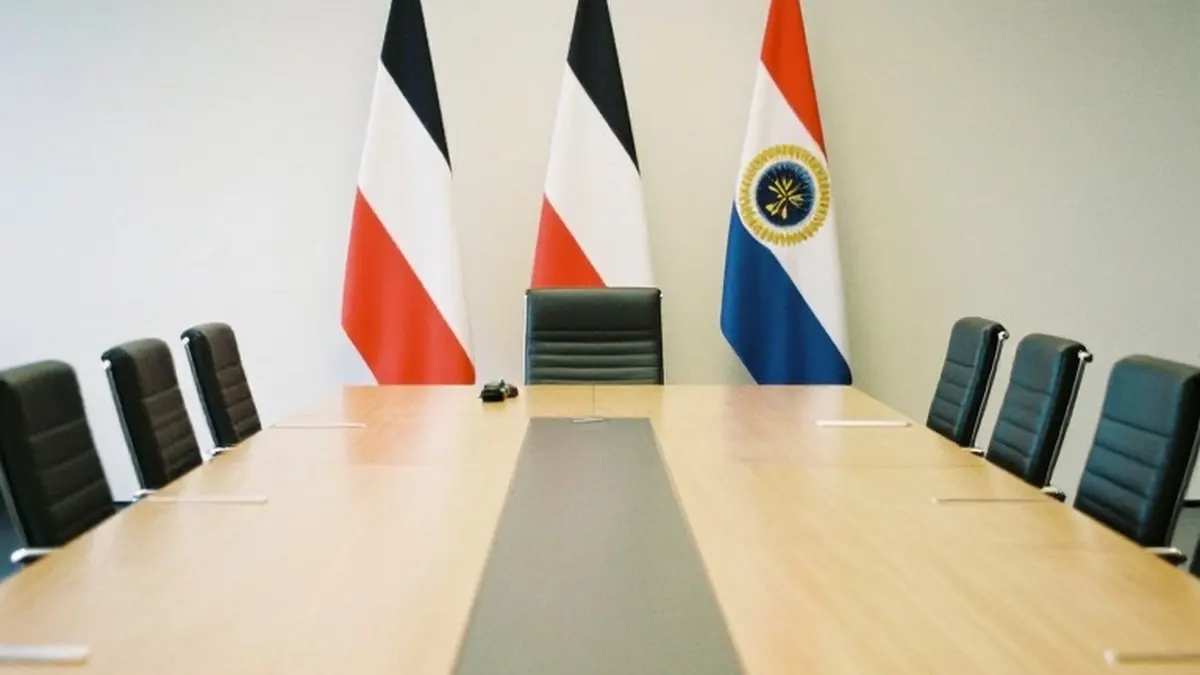
Director of National Intelligence Jay Clayton stated on Sunday that he trusts President Trump completely regarding the American relationship with Russian President Vladimir Putin. This assurance came shortly after the president referred to Putin, a perceived adversary, as a friend in recent social media posts and at a diplomatic summit.
During an interview on CNN’s State of the Union, host Dana Bash presented Clayton with two Truth Social posts where the president described both Putin and Chinese President Xi Jinping as friends. Bash questioned the director on whether he believed Putin was truly a friend to the United States. Clayton responded by describing the president as the greatest conductor of foreign policy during a challenging period.
Clayton highlighted the historic nature of the recent diplomatic efforts, noting that the president managed to bring the three major nuclear powers together to agree on communication and non-escalation. He argued that in this specific context, the language chosen by the president was appropriate, and he placed his complete trust in that judgment.
When pressed further on the friend terminology, Clayton suggested that different words could be used in different contexts. He emphasized that the president’s ability to organize the summit and convene the three leaders was a remarkable achievement in international diplomacy.
President Trump, who has maintained a cordial relationship with Putin for years, met with the Russian leader and Xi at a trilateral summit in Shenzhen, China. Upon arriving for the meeting on Thursday, Trump reportedly said of Putin, “Who is he? He’s my friend,” before approaching the Russian president.
The primary objectives of the gathering were to explore paths toward peace in the Russia-Ukraine war and the Iran conflict, alongside pushing for denuclearization. According to a joint text released by the three nations, the leaders established a declaration toward peace that addressed United Nations reform, oil production and supply, the International Criminal Court, and nuclear conflict.
Earlier in the week, President Trump told reporters that he believed Putin was backing down slightly in the Ukraine war, which is set to reach its five-year mark in February. This assessment contrasts with the views of Ukrainian President Volodymyr Zelensky, who has led the defense against Russian advances with support from the U.S. and Europe.
On Saturday, Zelensky commented that the summit turned out very badly for Russia. Writing on the social platform X, he noted that Putin did not achieve his desired outcome, which he referred to as a Yalta 2, a reference to the 1945 Allied talks on defeating Nazi Germany. Zelensky observed that China did not allow itself to be drawn into border changes, and Ukraine was not discussed in the bilateral talks between the United States and Russia.
Zelensky expanded on his analogy, stating that if the intention was to reaffirm victory over fascism, the participants should have included the United States, Europe, and Ukraine, rather than Russia. He added that if Putin wished to remind the world of his character, it was unnecessary because Ukraine had not forgotten that he is a terrorist and a killer.
More News · National news · Report a business · Got a Story?