Trump's 250-Foot Arch Faces Legal Hurdles Near Arlington Cemetery
Veterans' groups and family members of fallen service members argue the gilded structure will alter the historic landscape and cast physical shadows on gravesites.
By Yasmin Parker ·
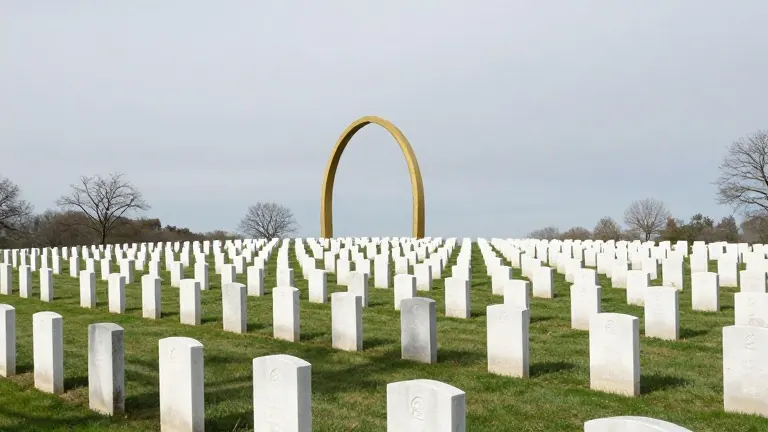
A federal judge has temporarily blocked the construction of a 250-foot-tall gold arch proposed by President Donald Trump near Arlington National Cemetery. The structure is designed to rise above the Lincoln Memorial and stand on a traffic circle approximately half a mile from the cemetery's main entrance in Arlington, Virginia. Legal challenges continue as courts weigh whether the project will fundamentally change the site.
The arch is part of a series of renovations intended to reimagine Washington, D.C. The project would add a gold and granite monument to a location where Congress mandated a memorial be built in 1925. Supporters argue the arch completes that long-standing plan and serves as a gateway connecting the District of Columbia to Arlington. Jared Craig, general counsel for Veterans for America First, stated that the design honors veterans and does not require changes to the cemetery itself.
Opponents contend the arch will disrupt the solemn atmosphere of the burial grounds. The cemetery contains more than 430,000 interments, including two presidents, more than a dozen Supreme Court justices, and over 400 recipients of the Medal of Honor. An estimated 3 million to 4 million people visit annually. Critics say the new structure will cast literal shadows on gravesites and introduce the noise of major construction and tourist traffic.
Bart Collart, father of Cpl. Spencer Collart, a Marine who died in a 2023 crash in Australia, has led the pushback. Collart was 21 when he died trying to save his pilots during a training mission. His father describes the proposed arch as a loud, boastful piece of marketing dropped onto sacred ground. He argued that the structure would dirty the hallowed ground where his son is buried in Section 52.
During a 10-hour hearing earlier this month, a planning commission approved the arch despite more than 100,000 public comments, many of which opposed the project. Bart Collart urged commissioners to respect the simple white headstones lining the roads. He noted that the cemetery’s design maintains a specific alignment between the Lincoln Memorial, Memorial Bridge, and Arlington House, a connection the arch may break.
Micki McElya, a historian at the University of Connecticut, described the site as the most hallowed ground in the United States. She said the area represents the nation’s military history and shifting values. Jimi Shaughnessy, a veteran and program manager at the National Parks Conservation Association, visits his great-grandparents' graves regularly. He warned that construction noise and the looming presence of the arch would intrude on the quiet setting needed for reflection.
The White House did not immediately respond to a request for comment. The project remains under legal review, with ongoing court battles determining its final status. The arch would stand taller than the existing Lincoln Memorial, altering the skyline visible from the cemetery and the surrounding area.