Trump urges faster federal executions in sharp rebuke of Newsom
The US President signed a new directive to accelerate death penalty cases while criticizing California Governor Gavin Newsom over recent mass commutations.
By Yasmin Parker ·
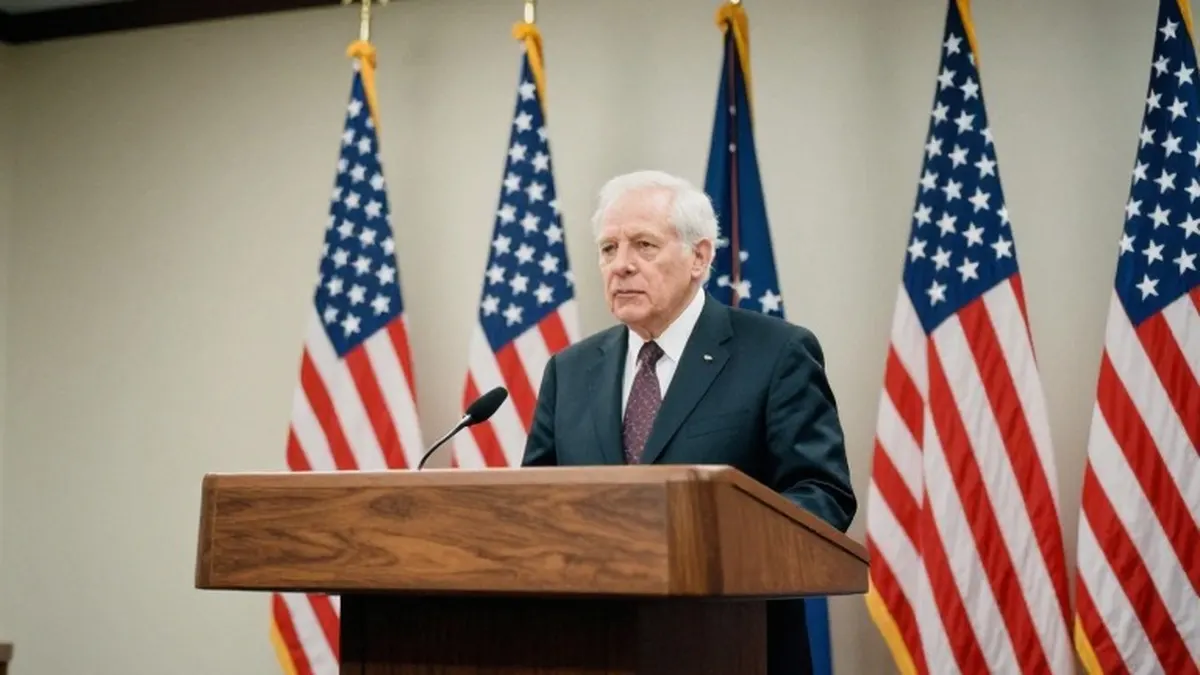
United States President Donald Trump reaffirmed his strong support for capital punishment during a recent event in Washington, DC. The gathering served a dual purpose, allowing the President to outline his administration's stance while launching a pointed critique of California Governor Gavin Newsom. Trump was joined by Attorney General Todd Blanche and the families of crime victims at the Department of Justice. He described the death penalty as a fundamental element of successful societies throughout history and declared that the administration would continue its pursuit of justice without yielding.
During the appearance, the President signed a presidential directive instructing the Department of Justice to seek the death penalty in specific murder cases involving children, rape, and human trafficking. The directive also orders the attorney general to expedite executions for individuals currently on federal death row. Additionally, Trump called on Congress to pass the Just Punishment for Murder Act, a bill sponsored by Republican Representative Brandon Gill. He stated that the legislation would strengthen the death penalty in America.
A significant portion of the speech was dedicated to attacking Newsom, a Democrat often viewed as a potential candidate for the 2028 presidential election. Newsom’s second term as governor concludes on January 4, and he is ineligible to run again in the 2026 midterm elections due to state term limits. Despite this, he has maintained a national profile as a prominent critic of the President. Trump focused on Newsom’s decision to commute the sentences of those on California’s death row, an action taken shortly after the midterm elections.
On November 5, Newsom announced that 548 people sentenced to death in California would instead receive life sentences without the possibility of parole. The Governor described this move as an extension of the execution moratorium he established when he took office in 2019. In an open letter, he explained that he could not remain true to his values while overseeing the execution of individuals with death warrants. He acknowledged that many Californians believe those who commit brutal crimes deserve to die, but he concluded that the state cannot morally carry out such killings.
Trump characterized the mass commutation as an effort to allow criminals to escape justice. He told the audience that they were gathering to stand against what he called a travesty and to support families who had been betrayed by the political system. He labeled Newsom a terrible governor who stole the only closure victims' families might have. Several family members were invited on stage to voice their opposition to the California Governor's decision. Sandra Friend, the mother of a murder victim, stated that the decision left families feeling abandoned by the state.
In response to the President's remarks, Newsom released statements from family members who supported his choice. Jess Nichol, the sister of murder victim Polly Klaas, argued that the death penalty should not be the answer when victims are divided. She emphasized that survivors deserve tangible support, including counseling, medical care, and financial assistance, rather than just a promise of justice through vengeance. This exchange highlights the ongoing political tension between the two leaders on the issue of capital punishment.
The debate occurs at a time when public support for the death penalty has declined. A November poll by Gallup found that 49 percent of US adults support the death penalty, marking the lowest rate since 1971. Opponents often cite the frequency of botched executions and the risk of executing innocent people. A nonprofit organization, the Death Penalty Information Center, has found that approximately 202 people formerly on death row were later found to be wrongfully convicted. This translates to an exoneration rate of one for every eight people executed in the US.
Before the recent commutations, California reportedly held the largest death row in the Western Hemisphere, accounting for roughly a quarter of the country's death sentences. Newsom’s successor, Governor-elect Xavier Becerra, has pledged to continue the death penalty moratorium once he takes office. This policy places California at odds with the federal push under Trump to embrace and expand the use of capital punishment.
Since returning to office in January 2025, Trump has signed several executive orders aimed at restoring the death penalty. He has pushed for execution to be the de facto punishment for the murder of law enforcement officers and in cases where undocumented immigrants are defendants. In April, the administration announced it would prioritize the death penalty by expanding acceptable execution methods, including firing squads. In October, Defense Secretary Pete Hegseth announced that the execution of Nidal Hasan would be livestreamed, a decision that drew backlash before Trump walked back the announcement after learning Hasan used a wheelchair.
During his first term, Trump oversaw 13 federal executions, the highest number for a president in decades. In his recent speech, he framed these punishments as common sense. He asserted that when it comes to defending the lives and safety of American people, there can be no compromise. The administration's aggressive stance signals a continued commitment to expanding the role of the death penalty in the federal justice system.