NASA confirms 30% brighter supermoon peak for November 23
The beaver moon reaches peak illumination at 9:54 a.m. ET, marking the first of three consecutive supermoons before year-end.
By Daniela Kelly ·
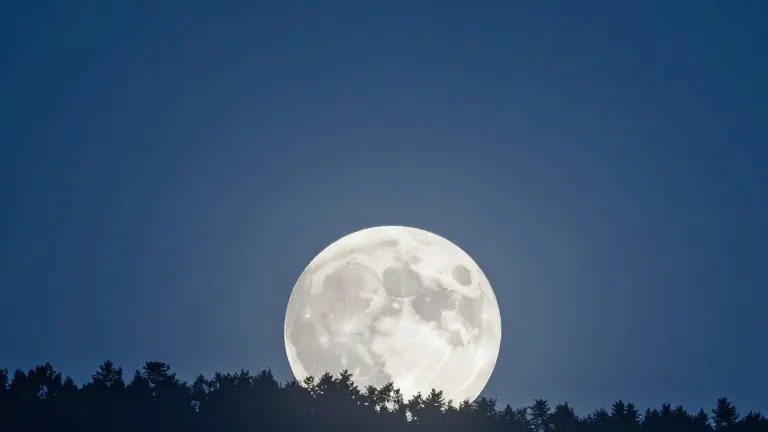
Noah Petro, chief of NASA’s Planetary Geology, Geophysics and Geochemistry Lab at Goddard Space Flight Center in Maryland, confirmed that the November full moon will appear 30% brighter than the year’s smallest full moon. The peak illumination occurs at 9:54 a.m. ET on November 23, according to EarthSky. Although the astronomical peak happens during daylight hours in the United States, the moon will appear full to the naked eye on the evenings of November 23 and 24, Petro said.
The event, locally known as the beaver moon, is the first of three consecutive supermoons this year. Kevin Lewis, vice chair and professor of Earth and planetary sciences at Johns Hopkins University in Baltimore, explained that the moon’s orbit is elliptical rather than a perfect circle. This orbital shape causes the moon to pass slightly closer to Earth at times, resulting in a larger apparent size in the sky, Lewis said.
Petro noted that the November full moon will also appear about 17% larger than the smallest full moon of the year. He added that individuals who regularly observe lunar phases will likely detect the difference in brightness and size. The phenomenon is not unique to November, as the moon takes approximately 27.5 days to return to its closest point to Earth and about 29.5 days to complete a full cycle of phases.
These similar time frames allow the full moon to coincide with its closest approach to Earth for several months in a row, Lewis explained. No special equipment is required to view the supermoon, though binoculars or telescopes can reveal surface details. These include craters and lunar seas, which are vast, dark plains formed by ancient lava flows, according to NASA.
Petro recommends viewing the moon from a dark area with an unobstructed view of the sky. He advised staying away from trees, tall buildings, and bright artificial lights to maximize visibility. Lewis suggested looking up shortly after sunset, when the moon is low on the horizon. At that elevation, the moon may appear larger than it actually is due to the moon illusion, an optical phenomenon where the brain compares the moon’s size with nearby objects like rooftops.
The moon’s gravitational pull influences Earth’s ocean tides, with full moons contributing to larger high tides, Lewis said. He noted that upcoming missions aim to explore the lunar surface further and potentially return humans to the moon in the coming years. Lewis stated that it is especially exciting to observe the moon now given the active phase of exploration.
The next full moon, known as the cold moon, will occur on December 23. The Old Farmer’s Almanac identifies it as the year’s biggest and brightest supermoon. The first full moon of 2027, called the wolf moon, is scheduled for January 22. Both events are expected to be visible under clear skies.