Violence surges during Palestinian olive harvest as settler attacks reach record levels
The United Nations reports that settler attacks in the West Bank have hit a twenty-year high, disrupting the critical olive harvest and straining local emergency services.
By Daniela Kelly ·
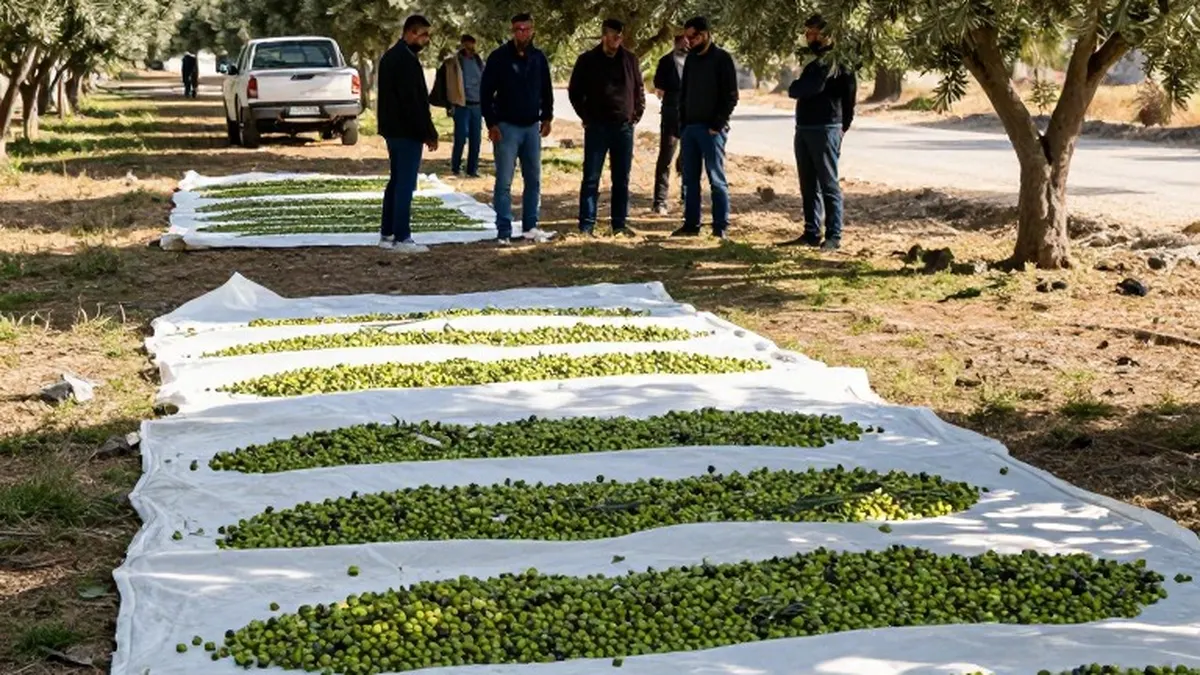
The annual olive harvest in the occupied West Bank has been marked by an unprecedented level of violence this year. According to United Nations records, the number of attacks by Israeli settlers against Palestinians and their property has exceeded figures from the last two decades. The surge in aggression has forced farming families to alter their traditional methods, gathering crops in short bursts and relying on group efforts to minimize exposure to potential confrontations.
Wala Zoran, a French resident who returns home to assist her family, described the unpredictability of the attacks. On October 10, her family was stoned by settlers in the village of Abu Mash'al while harvesting. Her cousin was shot in the leg and hospitalized. Zoran noted that despite efforts to avoid clashes, the settlers were close and aggressive, leaving the family unable to collect their full yield. The olive industry is vital, contributing up to 15 percent of the agricultural GDP in the Palestinian economy.
Political analysts attribute the increase in violence to the rapid expansion of settler outposts. Ibrahim Rabaya'a, a researcher based in Ramallah, described the spread of these small camps as a strategic escalation. He noted that more than 180 outposts have been established since 2023, often near Palestinian population centers. Rabaya'a characterized the settlers as organized and well-trained, acting like militias under the encouragement of the Israeli government.
In the central West Bank village of Abu Falah, tensions escalated on October 13 when settlers descended from a hilltop outpost and cut down dozens of olive trees. Residents blocked the road with heavy stones to prevent settlers from advancing by vehicle. A confrontation ensued, with Palestinians using rocks and firecrackers to defend their groves. The clash ended only after Israeli Defence Forces arrived and fired tear gas. A few days later, the village made international news when a U.S. photojournalist was severely beaten by a group of settlers.
Emergency services are facing significant pressure during the harvest season. The Israeli NGO Yesh Din has documented more than 25 settler incidents per day, ranging from vandalism to physical assault. Ambulances position themselves strategically to avoid delays caused by military checkpoints. Diyaa Murra, a university student volunteering with the Palestinian Red Crescent, stated that daily attacks have become the norm, prompting her to join the village defense system.
The impact on livelihoods is profound. Mohammad Ahmad, a Palestinian American, reported that he has never felt as affected by settler violence as in this season. He noted that access to much of the land is restricted. Many Palestinians must coordinate with the military to reach their trees, a process that has been contentious. The Israeli military claimed on social media in late October that 90 percent of coordinated harvests were complete, while the Palestinian Farmers Union stated that 55 percent of the crop remained unharvested.
In Deir Jarir, villagers attempted to harvest olives on October 21 with international activists for protection. However, they found an armored vehicle blocking their path. Israeli forces declared the area a closed military zone. A 72-year-old resident named Abu Asif described this season as the most difficult under occupation, noting that soldiers have even uprooted olive groves to prevent Palestinians from using them as cover.
Critics argue that the current government is allowing the violence to continue. Daniel Seideman, an Israeli lawyer and peace activist, stated that the Palestinians are defenseless and that the military often turns a blind eye to settler actions. He suggested that settlers view the current political climate as a unique opportunity to assert control over the West Bank. Prime Minister Benjamin Netanyahu has dismissed the attacks as the work of a small minority, but the proliferation of Israeli flags in Palestinian towns signals a growing psychological pressure.
In the town of Luban al Sharqiya, settlers recently covered a roadside cafe with Israeli flags. The owner, Muayad Hussein, was warned not to remove them. This display of presence is part of a broader effort to increase pressure on the local population. While some political parties in Israel have indicated potential future support for a Palestinian state, the current trend suggests a continuation of what analysts call silent annexation.
The olive harvest remains a potent cultural symbol of Palestinian connection to the land, making it a primary target for hard-liners. Despite the risks, families continue to gather their crops, knowing that the oil is essential for their survival and economic stability. The cycle of attack and defense continues as the season progresses, with both sides asserting their rights to the land and its produce.