Weizmann researchers create molecular Archimedes screw
Scientists have developed a single-molecule machine that converts electric current into continuous rotation, significantly boosting electrical conduction in the process.
By Yasmin Parker ·
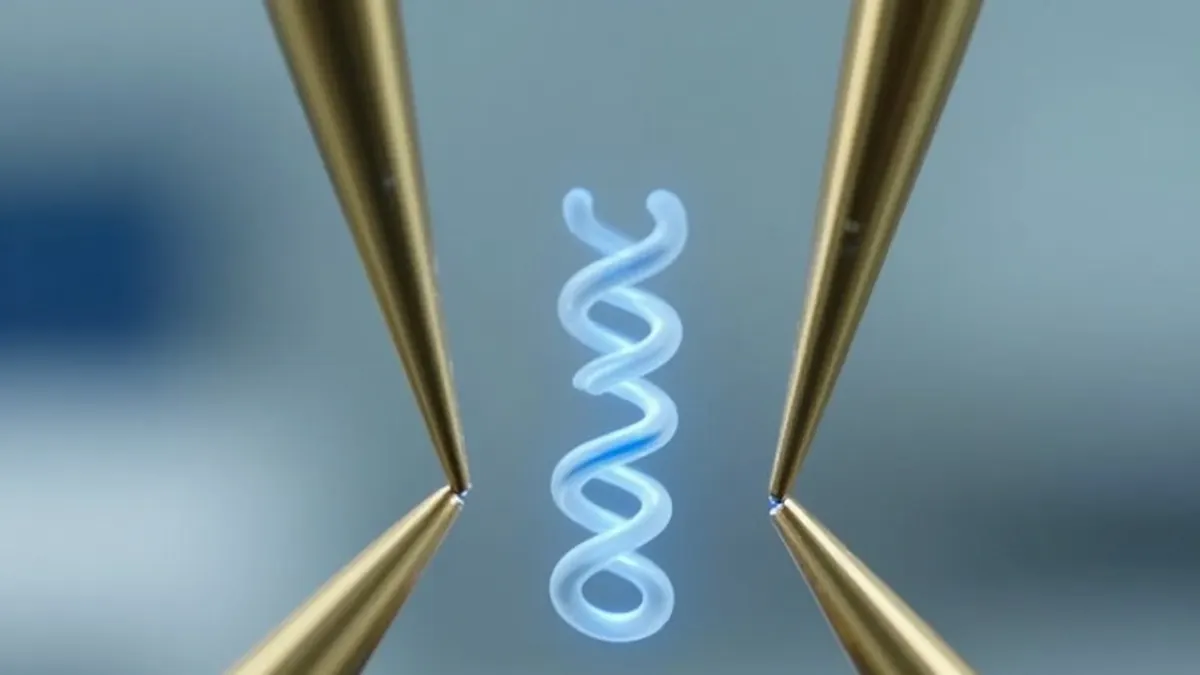
An international team of researchers has successfully scaled down the Archimedes screw, an invention with origins dating back more than two thousand years, to the scale of a single molecule. The original device, which functions as a giant corkscrew, is traditionally used to pump water or transfer bulk materials like grain. In modern engineering, the mechanism has also been adapted to operate in reverse as a turbine in hydroelectric power plants, where flowing water drives the screw to generate electricity.
The new discovery, published in the journal Nature by scientists from the Weizmann Institute of Science in Rehovot and collaborators, reveals a surprising two-way relationship between electric current and rotational motion. The study, titled 'Current-driven molecular machine with rotation-enhanced conductance,' demonstrates that when an electric current causes a molecule to spin, that rotation dramatically enhances the flow of electricity through it.
In the laboratory, researchers suspended a single helical organic molecule between two gold electrodes at a temperature near absolute zero. When voltage was applied, the team detected cyclical jumps in the electric current. These patterns indicated that the molecule was rotating steadily in a single direction. Reversing the current reversed the jump sequence, confirming that the molecule changed its direction of spin accordingly.
A major breakthrough occurred when the voltage was increased above a specific threshold. At this point, the current surged by up to one hundred times. Theoretical calculations suggest that this spike happens when the molecule transitions from step-by-step jumps into smooth, continuous rotation. This continuous spinning alters the molecule's physical configuration, creating a clearer pathway for electrons to pass through.
Prof. Oren Tal of the Weizmann Institute noted that the threshold for this surge can be controlled by stretching or compressing the molecule. He compared this adjustment to changing the angle of blades in a turbine. The study was led by Dr. Anil Kumar Singh, who conducted the experiments during his postdoctoral research at Weizmann before moving to the Indian Institute of Technology Madras.
The experimental setup required precise engineering to connect a molecule roughly a million times smaller than a human hair. The team created atomically sharp gold tips by snapping a thin wire inside a super-cooled vacuum chamber. By bringing these tips within a fraction of a nanometer, a single molecule bridged the gap, allowing electrons to flow from one electrode, through the spiral molecule, and to the other.
This discovery introduces a new operating principle for nanomachines. Unlike previous electric molecular motors that rely on stop-and-go excitation and relaxation processes, this device is driven directly by the force of the electrical current. The flowing electrons transfer momentum to the molecule, exerting a torque that drives its rotation, much like wind pushes the vanes of a windmill.
While the primary achievement is uncovering this new physical mechanism, the technology holds potential for future applications in molecular pumps, nanoscale switches, and energy storage. However, practical implementation will require scaling up to arrays of millions of molecules operating in unison. The team also faces the challenge of demonstrating the effect at room temperature, as the current experiments were conducted at 4.2 Kelvin to prevent thermal vibrations from interfering with the signals.
Future work will involve testing various chiral molecules to understand how shape affects force transfer and rotation speed. Researchers also plan to explore driving these machines using circularly polarized light or spin-polarized currents. This could link molecular machines to spintronics, a field that utilizes the magnetic spin of electrons alongside their charge.
Tal emphasized that while the operating conditions can be adjusted mechanically, establishing useful device functions remains a key challenge. The team is working to determine if these molecular machines offer practical advantages over existing technologies, aiming to organize the molecules with controlled orientation to produce a useful macroscopic effect.